Down memory lane – In search of S.E.K Mqhayi’s grave
Buntu Duku
In the pursuit of uncovering S.E.K Mqhayi's resting place in Berlin, obstacles abound. Despite fervent search and local aid, the poet's grave eludes our discovery this time around, leaving his legacy obscured amidst the landscape.
The road towards learning the truth about our origins and identity is endless. Our heritage remains our pride and motivation. Sometimes, however, you wake up to find the road barricaded by taxi drivers, hoping to draw attention from the government. So with our original plans to head toward Qam’imbola obstructed, we found ourselves on a hot Thursday morning, tongues out like dogs on a trail, searching for imbongi yesizwe Samuel Edward Krune Mqhayi’s grave in eNtabozuko (Berlin, East London).
Ntabozuko, also known as Berlin, is a small town on the way to East London from eQonce. For a town with just one street, you might assume finding what you seek would not be difficult.
Yet, without any signage for this proposed heritage site, the grave of S.E.K Mqhayi, we began our search at the old cemetery. With graves dating back to the early 1900’s, like any settler town, was dominated by few family names. The newer grave names reflecting the change brought by democracy.
With no luck there, we turned to our online sources. A measly three articles are published on the burial site exist from 2015, 2018 and 2022, all requiring a subscription. In our hungry state, we devoured what information we could, decided to return to the town centre, heading towards the landfill where our hero is said to be buried, on a neighbouring farm belonging to the Mqhayi family.
Passing the old church in Victoria street on our way from the cemetery, we decided to stop for directions, the old-school way. Though friendly, the ladies at Noah’s Ark play-school had no knowledge of the name or heritage site we were seeking and strongly advised against entering the landfill or surrounding farm without a guide. They did, however, leave us with some hope—a memorial statue in the park, though its purpose remained unknown to them.
We grew up on the works of this man. Yet, it saddens me to admit that no one in the town we asked had any clue about the author of “Ityala Lamawele” (The lawsuit of the twins), 1914, and “Don Jadu, 1929, one of his well known works.”
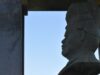
As our stomachs rumbled, the directions to the memorial grew faint. Onwards we went, meeting the main street in town, where, at the corner of Immigrant road and the R102, stood a memorial plinth with a stone bust beneath a gracious Milkwood tree.
The shade below the tree offered refuge from the scorching midday sun, and the dandelion stems served as perfect straws for our now lukewarm water. A pleasant corner in a pleasant town.
After setting up to take photos of the memorial, a refreshing moment came along when we struck conversation with a young passerby. “I know his first book and watched ‘Ityala Lamawele,'” said Thando Nongabe who lives in Litha, a neighbouring village. In the 1990s, every household likely enjoyed real family time while ‘Ityala Lamawele’ aired on SABC 1.
The four-sided memorial headstone was adorned with the history of S.E.K Mqhayi, while the fourth side, facing the road no less, paid tribute to the then MEC, Mrs Xoliswa Tom, responsible for unveiling the memorial stone on 29 September 2011.
Front: Samuel Edward Krone Mqhayi (00/12/1875-29/07/1945) was born near Gqumahashe, Alice, Eastern Cape, into a family of long standing Christian converts. He spent several of his early years in rural Transkei close to the homestead of his great uncle Chief Nzanzana. During this period Mqhayi acquired a remarkable knowldedge of Xhosa history, customs and language. He also acquired a good understanding of Xhosa judicial proceedings, as practiced in the court of Chief Tanzania. The influence of this period spent close to Chief Nzannzana is reflected in his evident love of Xhosa history and his mastery of the praise poem. He trained as a teacher at Lovedale institution and thereafter taught school in the Gompo District of East London. In 1905 he was appointed to the Xhosa Bible Revision board and he later helped codify Xhosa grammar and standardize Xhosa orthography.
Back: In 1907 Mqhayi wrote what is considered to be his first novel in the Xhosa language, uSamson, which was a version of the biblical story of Samson. In 1914 his iTyala Lamawele appeared inspired by another biblical story. Ityala Lamawele is a defense of Xhosa law before european administration. Mqhayi’s memories of Nzanzana’s court enabled him to provide a most illuminating picture of Xhosa judicial procedure. In the 1920’s Mqhayi wrote several biographies and Imihobe neminongo (1927, “songs of joy and lullabies”). The first published collection of Xhosa poems, many of which celebrate current events or important figures. A work of fiction, u-don Jadu (1929), describes utopian multicultural state that combines elements of Western society and Xhosa culture. Mqhayi’s autobiography, u-Mqhayi Was Ntab’ozuko (1939 “Mqhayi of the mountain of beauty”) gives a vivid picture of the late 19th century Xhosa life. Mqhayi’s collected poems, inzuzo (“reward”) were published in 1942. Mqhayi was the recipient of the May Ester Bedford prize for Bantu Literature in 1935. An Honorary doctorate was posthumously conferred by the University of Fort Hare.
The Left side of the plinth, facing the road
Though his first book was included in our school curriculum, there are no signposts to guide us to the great man’s final resting place or memorial as promised in 2018. It is our vision to make this information accessible for all who seek their roots, to honor our heroes. It is our mission to train a cultural and historic guide or spokesperson in every town, village, and community where a heritage site exists in the Eastern Cape. So, although no grave was found this time around, we continue on our journey to revive our heritage.
In his article published in 2015 by the City Press, Xolela Mangcu, Author and Professor at George Washington University wrote, concluding in a plea to the youth “I now make this appeal to the students of the #RhodesMustFall movement and their colleagues around the country: rebuild graves in every part of South Africa. Each grave has a story to tell. Bring those stories back into the classroom so we can construct a new curriculum. Bring your fellow white students along, so we can all build a new consciousness for our country.”
The words of a poet endure, but his resting place remains obscured, buried amidst the landfill. Where, then, do we pay our respects?